Mixed book and ornament displays in compact oak bookcases
A mixed collection works best when the shelf reads as a deliberate composition rather than a row of unrelated things. Solid oak furniture gives that composition a warm base. The grain, tone and simple lines can settle a room, especially where a bookcase sits in a compact living room, bedroom or study. An 80 cm wide bookcase has limited surface area, so each object has to earn its place.
The aim is not to hide the collection. It is to give books, ornaments, plants and keepsakes enough space to be seen. A crowded shelf can feel busy even when every item is loved. A well-spaced shelf lets the eye rest, and the oak frame becomes part of the display instead of a boundary fighting against it.
Start with the shape of the collection
Before moving anything, sort the collection by shape and use. Hardback books bring height and weight. Paperback books are lighter and more uniform. Ornaments tend to be small, irregular and easy to lose against a busy background. Houseplants add softness, but they also need clearance and a safe surface. Storage baskets can absorb smaller items that would otherwise scatter across the shelf.
This sorting is useful because it shows what the collection actually contains. A shelf with many tall books needs different spacing from one filled with small objects. A row of short paperback books may leave too much empty air above it unless something vertical breaks the line. A group of ornaments may look weak if it sits under a very tall shelf gap. The display should be planned around those differences.
In narrow spaces, it helps to treat each shelf as a small zone. One zone might hold reading books. Another might hold a plant, a framed object and two ornaments. A third might use baskets for items that are useful but not attractive on open display. This prevents every shelf from trying to do the same job.
Use shelf spacing as a design tool
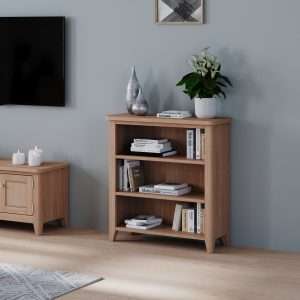
shelf spacing sets the rhythm of the whole bookcase. Books arranged upright create strong vertical lines. When those lines run across every shelf, the display can look rigid. Breaking them with a low bowl, a small plant or a stack of books laid flat gives the eye a pause. The pause matters more in a compact bookcase, where the viewer sees the whole piece at once.
Adjustable shelves are helpful here, if the bookcase allows it. Taller shelves suit hardback books, large ornaments and plants with a bit of height. Shorter shelves suit paperback books, small keepsakes and baskets. If the shelves are fixed, work with the spaces rather than forcing a perfect arrangement. A short object on a tall shelf can look intentional when paired with something above or beside it.
Leave a little air above groups of objects. This is one of the simplest ways to make a display look calm. A plant needs room for its leaves. A tall ornament needs space so it does not look pressed into the shelf above. Books can sit closer together, but even they benefit from a small gap at the end of a row.
Think in groups, not single items
A single ornament floating in a large gap often looks accidental. The same ornament placed with two related pieces can look considered. Grouping gives small objects visual weight. Try clustering by colour, material, height or subject. A set of neutral pieces can sit together, while a brighter object can stand apart as a focal point.
Groups also make a mixed collection easier to read. Books can be grouped by size or colour without needing to be strictly matched. Ornaments can be grouped by theme, such as ceramic, glass, metal or natural textures. Houseplants can sit near objects that echo their green tones or their organic shape. The point is to create small relationships across the shelf.
On wooden bookshelves, contrast does much of the work. Pale objects stand out against darker oak, while deeper colours can feel grounded against a lighter finish. Texture matters too. Smooth ceramic, matte paper, woven baskets and glossy leaves each catch light in a different way. A mix of textures keeps the display from looking flat.
Balance height, weight and empty space
visual balance does not mean perfect symmetry. A tall vase on one side can be balanced by a stack of books and a low ornament on the other. A heavy group of books can feel lighter if the shelf above has only a few carefully chosen pieces. What matters is that no single area feels overloaded while another looks bare.
Heavy items belong on lower shelves where possible. This is practical as well as visual. Large hardback books, dense ornaments and filled baskets feel more stable low down. Light ornaments and delicate pieces can sit higher, provided they are not likely to be knocked. In a bedroom or study, the bookcase may also be close to a desk or bed, so think about what might brush past it.
Empty space is part of the arrangement. It gives the oak its own presence and stops the display from becoming a wall of objects. A good test is to look at the bookcase from a normal standing position. If every gap feels like a problem, the shelf may need fewer items. If one shelf looks sparse while another is packed, move one or two pieces before adding anything new.
Mix books with objects in a natural rhythm
Books provide structure, and objects provide character. A useful pattern is to begin with a row of books, then add a small object at one end, then continue with another shorter group. A stack of books laid flat can act as a plinth for an ornament, though the object should be stable and not too tall. This creates levels without needing extra furniture.
Hardback books can carry a display because their spines and covers add colour. Paperback books are useful for filling gaps, especially where a shelf has a modest height. If a row of books leans, support it with a bookend or a solid object rather than leaving it to slip. Leaning books can look relaxed, but they can also make the whole shelf seem untidy.
When a collection includes both reading books and display pieces, decide which shelves are flexible. The shelves used most often should stay easy to access. A favourite read buried behind ornaments is unlikely to be picked up. Display pieces can sit on higher or lower shelves that are not used as often.
Use storage without hiding the whole display
storage baskets and drawer storage can make a mixed collection feel cleaner. They are especially useful for items that repeat, look awkward or belong together but should not be on show. Small notebooks, cables, craft bits, loose photographs and small ornaments can all be gathered into a container. The key is to keep the storage visible as part of the design, not as an afterthought.
Baskets work well on lower shelves because they can be pulled out and replaced easily. Drawer storage suits a study or bedroom where the bookcase doubles as a practical unit. A drawer breaks up the open shelving and gives the eye a solid block to rest on. This can be helpful when the rest of the display is varied.
Avoid filling every open space with storage. If all the shelves are hidden, the bookcase loses the display quality that makes it useful in the first place. A mix of open and contained storage usually reads better. The contained areas handle clutter, while the open areas show the pieces worth seeing.
Keep plants simple and safe
Houseplants can soften the straight lines of books and oak shelves. Trailing varieties add movement, while upright plants add height. In a compact bookcase, smaller plants are usually easier to place. They leave room for books and ornaments, and they are less likely to dominate the shelf.
Use a saucer or closed pot that protects the wood from water. Check that leaves do not press against the shelf above, and leave enough gap for growth. If a plant needs bright light, place it where that light actually reaches it rather than tucking it into a dark corner. A healthy-looking plant adds far more than one that is struggling to fit.
Adjust as the collection changes
A display does not need to stay fixed. Books get read and moved, ornaments are gifted, plants grow and baskets fill. A shelf that looks balanced in one season may need a small change later. Short adjustments are easier than a full reset, so keep a few spare objects in mind: one low piece, one tall piece and one item with colour.
When the arrangement feels wrong, look for the cause before adding more. Common issues are too many similar heights, too many small objects in one place, heavy items high up, or no gap between groups. Fixing those problems often makes the collection look more intentional.
Mixed collections have an advantage over perfectly matched displays. They reflect different interests and changing tastes. With clear shelf spacing, grouped objects and a little restraint, even a narrow bookcase can hold books, ornaments, plants and storage without feeling crowded. The oak frame gives the arrangement a steady backdrop, and the objects give the room its character.